On the invisible conditions that make meaning possible in artisan food.
There is a category of product that consumer psychology has never quite found the right language for. It is not luxury, though it is sometimes expensive. It is not heritage, though it often carries history. It is not artisan in the marketing sense — the word has been so thoroughly colonised that it no longer reliably points at anything. The category I am trying to describe is something more specific: things that carry time inside them. Things that allow the person who encounters them to feel themselves in relation to something longer and deeper than their own moment.
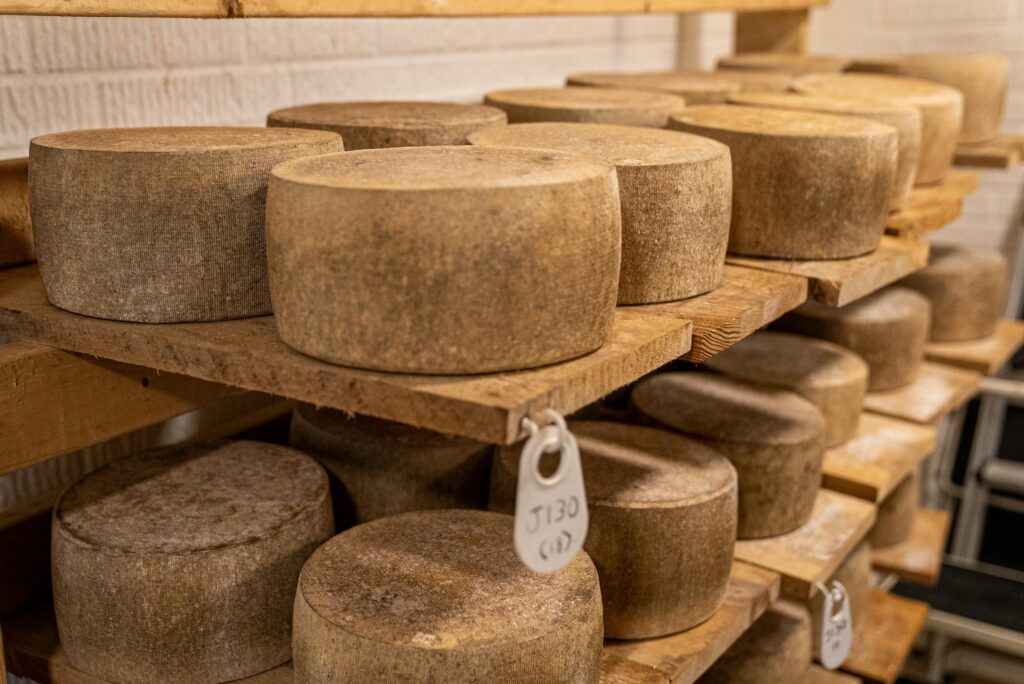
A properly aged cheese is one of these things. Not because it is old, but because it is the outcome of a process in which time is a structural ingredient — a material condition of the thing’s very existence. The rind is a record of duration. The interior is the result of microbial cultures doing their patient work across months or years. The flavour is the flavour of time itself, acting on matter in a specific place, under specific conditions, guided by a specific tradition of human attention. Remove the time, and you have something different. Though not necessarily a worse version of the same thing, just a different thing.
At some point, however, the question arrives. A distributor wants more volume, a retailer wants a consistent supply, and an investor wants to know what the growth plan looks like. The producer who has been making the same cheese in the same cave for twenty years knows, in some unarticulated way, that saying yes to all of this would change something essential. But they can’t quite say what. The product would still be there, the name would still be there. But something else would have left.
That difficulty — the inability to name precisely what is at stake — is not a failure of intelligence or conviction. It is a structural problem. The thing that would be lost doesn’t have an adequate term in the conventional vocabulary of food production, quality assessment, or heritage management. And without a term, it is very hard to defend.
This NOZ CaseNotes piece proposes one. It is called a time object — and once we have the concept, a great many decisions that previously felt like difficult trade-offs become something clearer: choices about whether to remain the thing you are, or to become something different that happens to carry the same name.
The category of time objects
The philosopher Edmund Husserl wrote about what he called time-consciousness: the way in which human experience is never simply present but always carries within it a sense of what has just been and what is about to come. We are, in Husserl’s account, beings who are constituted by temporal depth — not frozen in the present moment but always oriented by the past that is still living in us and the future we are already leaning toward.
Time objects, in this sense, are things that externalise this temporal depth. They allow us to feel, through our encounter with them, the density of duration. A cathedral does this through stone — through the particular weight of a building that has been prayed in across centuries, that carries in its proportions and its wear the accumulated presence of all those who have passed through it. A long-established festival does it through repetition — through the specific character of a return, the recognition of something that was here before you arrived and will continue after you leave. And a properly made artisan cheese does it through fermentation — through the encounter with a living product whose character is the direct result of time’s action on matter.
The person who buys a cheese aged for eighteen months in a specific cave is not buying a product. They are buying a relationship with a process that took eighteen months to complete, in a place they may never visit, by a maker they may never meet.
This is not a sentimental observation. It has precise strategic consequences for how artisan food companies understand what they are producing, what they are selling, and what is actually at stake when they make decisions about scale, distribution, and process.
What the conditions produce
Every time object is the outcome of conditions. This is the structural fact that most strategic thinking about artisan food manages to acknowledge sentimentally while missing it analytically. The conditions are not the backdrop to the product. They are the product’s constitution. Change the conditions, and you change — in some essential way — the thing itself.
Consider what the conditions of traditional cheesemaking actually include. The microbial ecology of a particular cave or dairy — the specific community of bacteria, yeasts, and moulds that are present in a specific place and that have co-evolved over generations with the practices of the humans who work there. The rhythms of animal husbandry — the seasonal variation in milk composition that results from what the animals eat, when they give birth, how they are kept. The temperature and humidity of the ageing environment — the specific atmospheric conditions that determine the pace and character of fermentation. The attention of the affiner — the practice of turning, brushing, washing, and reading that requires a kind of embodied knowledge that is not fully codeable.
None of these conditions can be fully reproduced elsewhere. Some can be approximated, but approximation produces a different relationship between the product and its conditions — and therefore a different product. The cave ecology that took centuries to establish cannot be installed. The seasonal variation that comes from a specific landscape cannot be simulated without loss. The embodied knowledge of a skilled affiner cannot be replaced by a protocol, because the protocol would need to be infinite to cover all the variables that the human expert navigates intuitively.
The strategic misunderstanding
The most common strategic misunderstanding in artisan food is the belief that what makes the product valuable is the story rather than the conditions. This misconception is understandable; stories are scalable, while conditions are not. And so companies facing growth pressure move, sometimes gradually and sometimes rapidly, toward a model in which the narrative of the conditions is maintained while the conditions themselves are progressively rationalised.
The cave becomes a controlled environment with similar temperature parameters. The seasonal milk becomes a standardised supply. The traditional culture becomes a commercial starter. The affiner becomes a team following a standard operating procedure. Each individual rationalisation is defensible. The product remains excellent by most objective measures. But something has changed — something that the loyal customer feels before they can name it, and that eventually surfaces as a sense that the thing they used to love is no longer quite what it was.
What they are sensing is not the decline of quality in any conventional sense. They are sensing the thinning of the temporal depth that made the product a time object rather than a very good cheese.
The product has moved from being the outcome of irreducible conditions to being the outcome of replicable processes. It has moved from being particular to being reproducible. And in making that move, it has lost its membership in the category of things that allow us to feel ourselves in relation to something larger and longer than our own moment.
Holding the conditions
The artisan food companies that navigate this well are the ones that have developed a precise account of which conditions are constitutive — which are the conditions whose removal would change the category of the thing, not merely its specifications — and which are merely contingent features that can be adapted without essential loss.
This distinction requires genuine knowledge of the product at a level that goes beyond quality control. It requires understanding what the conditions actually do — what the cave ecology contributes that cannot be replicated, what the seasonal variation produces in the milk that a standardised supply cannot, what the affiner’s attention creates that a protocol would miss. It requires, in other words, an account of the product’s identity that is rigorous enough to survive commercial pressure.
Most artisan food companies do not have this account. They have a story, which is essentially not the same thing. A story describes what the conditions. An identity account explains why the conditions are constitutive: what they produce in the product that would be lost in their absence, and why that loss would matter to the people who have chosen this product as a way of locating themselves in relation to something larger than the present moment.
Building that account is the strategic work that most matters for an artisan food company navigating growth. Not the marketing strategy, or the distribution plan. The prior question being: what are we, actually — and what are the conditions that we need to protect?
The cheese that takes eighteen months to make is a time object for what it is, and not for the story it tells. The task of artisan food strategy is to understand that difference clearly enough to know which decisions can deepen the thing, and which dissolve it — and to act accordingly, even when the dissolving option is easier to explain to investors or more legible to the distribution partner.
That knowledge, held clearly and applied consistently, is the difference between a company that grows and a company that remains. Between a product that becomes a time object and one that merely tells the story of time.